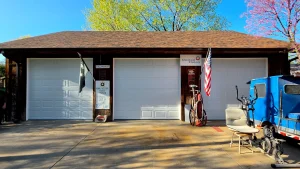
A thin line of daylight under the whole garage door and a triangular opening under one corner may look like versions of the same problem. They are not. The first may come from a worn bottom seal or a close limit that stops short. The second may point to an uneven slab, an out-of-level door, or trouble in the track and counterbalance system.
That distinction should come before anyone sells you weatherstripping. Sharp Overhead Door Service takes a diagnosis-first approach for Kansas City homeowners: identify whether the gap follows the floor, the seal, the door, or the opener, then explain what is necessary without a pushy upsell.
What the Shape of the Gap Can Tell You
Use the closed door as a visual reference, but do not place your hands beneath it or make adjustments. Look from inside the garage while the door is stationary.
| What You See | More Likely Causes | Best Next Step |
| A narrow, even line across most of the width | Compressed bottom seal or a close limit set too high | Inspect the seal and note whether the door stops smoothly |
| A dip or opening that follows one low spot in the floor | Uneven, settled, cracked, or intentionally sloped slab | Compare the floor line with the bottom edge of the door |
| A wedge-shaped gap under one corner | Door out of level, cable or drum trouble, track problem, or slab slope | Check whether the top edge and sections also look tilted |
| The seal touches, then the door reverses open | Obstruction, too much travel, resistance, or opener setting issue | Clear loose debris and use the exact opener manual |
| The gap appeared after an impact or repair | Shifted track, damaged section, changed balance, or incorrect setup | Arrange a complete system inspection |
| Daylight changes as the door shakes or descends unevenly | Roller, track, cable, spring, or balance trouble | Stop operation and request professional diagnosis |
The pattern narrows the possibilities, but it does not prove the cause. A new seal cannot level a crooked door, and more opener travel cannot flatten a slab.
1. The Bottom Seal Is Worn, Torn, or the Wrong Fit
The bottom seal is the flexible material attached to the lower edge of the door. It compresses against small surface variations when the door closes. Age, repeated compression, dirt, sunlight, temperature changes, and contact with the threshold can leave it flattened, split, brittle, pulled out of its retainer, or folded under itself.
A seal problem is more likely when the door sits square in the opening, moves smoothly, and leaves a similar gap across much of its width. Look for visible cracks, missing sections, a loose end, or material that no longer rebounds. Also check whether the retainer is bent or corroded, because replacement material cannot seat correctly in a damaged channel.
Do not assume the thickest available seal is the answer. The correct profile must fit the existing retainer, and excessive material can interfere with closing or trigger reversal. Some retainers or lower door sections may need repair before a seal can work.
A focused garage door repair may involve only the seal when the door, floor, retainer, and opener setup are otherwise sound. That is a diagnosis, not the default conclusion for every gap.
2. The Concrete Slab Is Uneven or Sloped
Garage floors are not always level across the opening. A slab may have a drainage slope, a localized low area, settlement, surface damage, or a high spot near one jamb. When the rigid bottom edge of a level door meets an irregular floor, the flexible seal can bridge only a limited difference.
The key clue is that the gap follows the concrete while the door itself remains level. Stand back and compare the bottom of the door with the section joints and the top edge. If those lines remain parallel but the daylight widens only where the floor drops, the slab is a stronger suspect than the tracks.
This diagnosis matters because lowering one side of a level door to chase a low spot can create a crooked operating condition. Likewise, programming the opener to press harder against the floor can overcompress the seal without filling a localized depression.
The appropriate remedy depends on the amount and shape of the variation, drainage needs, door construction, and retainer. It might involve a correctly selected flexible seal, a compatible threshold solution, concrete evaluation, or another site-specific correction. Avoid any threshold that redirects rainwater into the garage or obstructs safe door travel.
3. The Door Is Out of Level
If the bottom edge, section joints, and top of the door all tilt in the same direction, the door may be sitting out of level rather than simply meeting a sloped floor. Other warning signs include one side arriving first, a jerking descent, a loose cable, a cable that is no longer seated correctly on a drum, scraping, or a roller that appears displaced.
These clues move the problem out of the weatherstripping category. Lift cables and springs work together to support and balance the door. The Door & Access Systems Manufacturers Association (DASMA) warns that cables associated with the spring system are exposed to high spring tension and should be replaced only by a trained technician.1
If the door is crooked, unusually heavy, or visibly unbalanced, do not use it again until a trained garage door technician has inspected it. Keep people, pets, and vehicles away, and do not pull the emergency release. Do not touch the cable, drum, spring, bottom bracket, or related hardware.
Those components can store or transmit dangerous tension. A visible gap is less important than stabilizing the door and correcting the cause.
4. Track, Roller, or Balance Trouble Keeps the Door From Seating
A door can appear nearly level at rest yet fail to reach the floor evenly because a roller binds, a track has shifted, a hinge or section is damaged, or the spring system is out of balance. Listen for a scrape, pop, or hesitation at the same point in travel. Watch from outside the path for one edge slowing before the other.
DASMA states that a door that does not move smoothly may have an unsafe condition. If awkward manual operation continues, the spring system may be out of balance and should be repaired only by trained professionals.1
Do not loosen track fasteners to pull the door downward. Do not remove a bottom bracket or attempt to reset a cable. Even when the visible symptom is a small gap, the repair may involve alignment and balance rather than sealing.
Sharp offers spring repair and replacement and cable replacement when inspection shows that tensioned hardware is involved. The goal is to correct the reason the door is not seating, not disguise it with extra rubber.
5. The Opener’s Close Limit Is Incorrect
The close-travel limit tells the opener where to stop. If it is set too short, a mechanically sound door may stop just above the floor and leave a consistent gap. If it is set too far, the door may press into the slab, flex, strain, or reverse.
A limit issue is more plausible when the door is level, the gap is repeatable, movement is smooth, and the symptom began after opener work, programming, or a power-related reset. It is less plausible when the door tilts, binds, feels heavy, or shows cable, spring, roller, or track damage.
Do not add closing force or extra travel to overcome resistance. DASMA explains that openers are designed for properly balanced doors and that a heavy door needs diagnosis, not a more powerful operator.2 Follow only the instructions for the exact opener model after mechanical problems have been ruled out. Sharp’s garage door opener repair and replacement service can evaluate the door and operator together.
Why a Bottom Gap Matters in Kansas City
A gap is not only a cosmetic line of light. It creates an uncontrolled path for outdoor air, windblown debris, water, and pests.
Kansas City International Airport’s 1991–2020 climate normals show an average temperature of 29.0°F in January and 78.2°F in July.3 An opening at the threshold makes winter drafts and hot summer air more noticeable, especially in an attached garage or a garage used as a workshop. Sealing the gap can reduce that direct air path, although it will not turn an unconditioned garage into conditioned living space.
Rain is also practical, not decorative, local context. The same NOAA dataset reports normal monthly precipitation above four inches in April, May, June, July, August, and September.3 Wind can drive rain and leaves toward an exposed threshold. A sound bottom seal can help with minor exposure, but it cannot correct exterior drainage that directs water toward the garage. Recurring water entry deserves both door-seal and drainage evaluation.
Pest exclusion is another reason to address daylight. University of California Integrated Pest Management reports that young rats can squeeze beneath a door with a one-half-inch gap and recommends tight-fitting exterior doors, sealed thresholds, door sweeps, or weatherstripping.4 A garage door seal alone cannot eliminate a pest problem, but an obvious opening is worth correcting.
Safe Checks You Can Make Without Adjusting the Door
You do not need to identify the failed part before calling. A few observations can make the diagnosis more efficient:
- Keep the door closed and stationary. View the gap from several feet away and note whether it is even, curved, or wedge-shaped.
- Compare horizontal lines. Look at the bottom edge, section joints, and top edge. If all tilt, report that the entire door appears out of level.
- Inspect the seal visually. Note tears, flattened areas, missing pieces, a loose end, or a bent retainer without reaching under the door.
- Look at the floor. Identify cracks, low areas, high spots, standing water, or an obvious drainage slope.
- Record operating behavior only if the door has been moving normally. Note whether it closes smoothly, reverses, scrapes, shakes, or leaves the same gap every time.
- Stop for mechanical warning signs. If you see spring damage, a loose cable, a crooked door, a displaced roller, or a heavy or unbalanced condition, keep the door out of service.
Do not perform a balance test on a door that is already crooked, damaged, partly open, or showing spring or cable trouble. Do not crawl beneath it to measure the gap.
What Does It Cost to Fix a Gap Under a Garage Door?
There is no honest single price because the visible gap can represent very different work. Replacing compatible seal material is not the same scope as repairing a damaged retainer, correcting opener travel, resetting tracks, replacing tensioned hardware, addressing a damaged section, or adapting the opening to an uneven slab.
Cost factors include:
- Door width, height, material, weight, and construction
- Seal profile, retainer condition, and parts availability
- Size and pattern of the floor variation
- Whether the door is level and properly balanced
- Track, roller, hinge, cable, spring, or section damage
- Opener model and whether limits can be set correctly
- Access conditions and urgency of service
- Any separate concrete or drainage work the site requires
Sharp does not publish a one-price-fits-all figure for this symptom, so this article will not invent one. A useful estimate follows diagnosis and explains which work is necessary, which is optional, and why. That fits owner Steven Ramilo’s position that diagnostics are important and the job should be done right without pushy sales gimmicks.
Frequently Asked Questions
Can I Replace Only the Garage Door Bottom Seal?
Sometimes. Seal-only replacement makes sense when the door is level, balanced, operating smoothly, and meeting a reasonably even floor with an intact retainer. If the slab is uneven, the door is crooked, or the opener stops short, a new seal may not solve the gap.
How Can I Tell Whether the Floor or Door Is Uneven?
Compare the door’s bottom edge with its section joints and top edge. Parallel, level door lines above a floor-shaped gap point more toward the slab. A tilt that continues through the whole door points toward door alignment or balance trouble and needs professional inspection.
Should a Garage Door Bottom Seal Touch the Floor?
It should make consistent contact sufficient to close ordinary small gaps without being crushed excessively. The exact fit depends on the door, retainer, seal profile, and floor. Heavy compression is not a substitute for correcting an uneven floor or incorrect travel.
Can I Lower the Opener Limit to Remove the Gap?
Only if mechanical problems have been ruled out and the exact model instructions support the adjustment. More travel can make the door press into the slab and reverse. Never use limit or force changes to compensate for a crooked, binding, heavy, or unbalanced door.
Is a Crooked Gap Under the Door Dangerous?
It can be. A wedge-shaped gap paired with tilt, a loose cable, jerking, scraping, or uneven movement may indicate track or counterbalance trouble. Do not operate the garage door until a trained technician has inspected it, and do not touch tensioned hardware.
Will a Threshold Seal Stop Rain From Entering?
A compatible threshold may help with minor water at a suitable opening, but it should not be treated as a cure for drainage that sends water toward the garage. The door fit, bottom seal, slab slope, and exterior water path should be evaluated together.
Can Mice or Rats Enter Through a Garage Door Gap?
Yes. UC IPM notes that young rats can squeeze under a one-half-inch door gap.4 Correcting the opening helps with exclusion, but food, clutter, damaged screens, and other exterior openings may also need attention.
Get the Gap Diagnosed Before Buying a Fix
A gap under your garage door is a symptom, not a parts order. Sharp Overhead Door Service can inspect the seal, floor contact, door level, tracks, balance system, and opener limits, then explain the smallest responsible repair. That may be a seal, but it may be alignment, opener setup, tensioned hardware, concrete or drainage work, or a combination.
For a straight diagnosis in Kansas City, Liberty, Smithville, Kearney, Independence, Lee’s Summit, Blue Springs, and nearby Missouri communities, contact Sharp Overhead Door Service or call (816) 536-7699. Share the shape of the gap, whether the door sits crooked, and whether it has started scraping, reversing, or moving unevenly.